
Industrial Area Lighting: Choosing the Right Lighting Solution
August 24, 2026 · Hikari Penta Sarana
Industrial Area Lighting: Choosing the Right Lighting Solution for Industrial Facilities
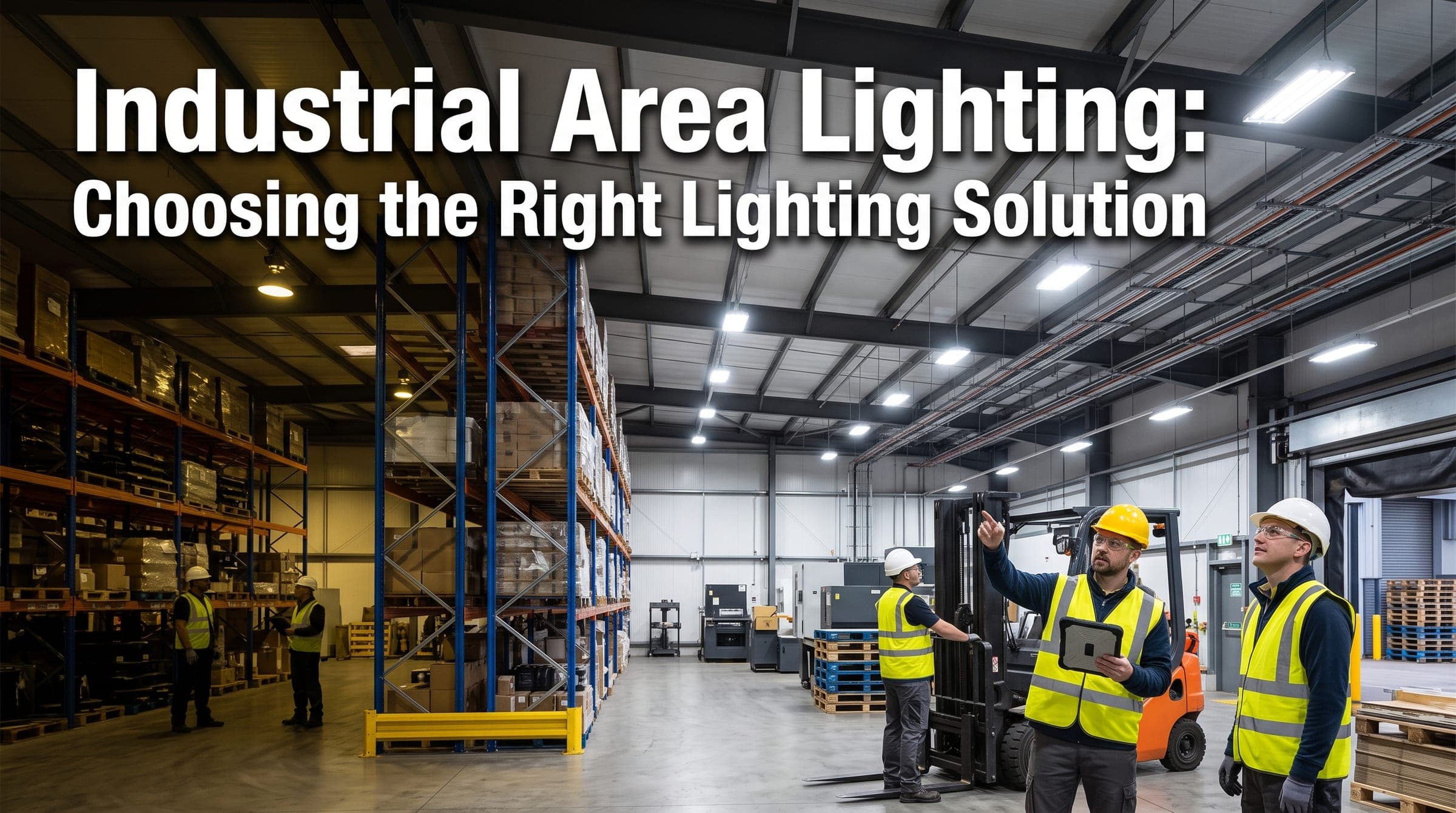
Industrial facilities require more than simply “bright” lighting. From manufacturing plants and warehouses to loading areas, parking lots, access roads, and outdoor storage yards, each area has different lighting requirements.
This is where industrial area lighting plays an important role. A well-designed area lighting system provides adequate visibility, supports safer movement, improves visibility around operational areas, and helps facilities maintain efficient lighting performance.
What Is Area Lighting?
Area lighting refers to lighting designed to illuminate relatively large spaces rather than a specific task or object.
In an industrial environment, area lighting can be used for:
- Outdoor storage yards
- Loading and unloading areas
- Parking areas
- Factory surroundings
- Access roads and circulation areas
- Industrial compounds
- Building entrances
- Perimeter and security areas
- Logistics and distribution facilities
Unlike indoor task lighting, outdoor area lighting must account for factors such as mounting height, beam distribution, spacing between luminaires, surrounding structures, weather exposure, and vehicle or pedestrian movement.
The objective is not simply to produce a high amount of light, but to distribute light effectively across the intended area.
Why Is Industrial Area Lighting Important?
Industrial facilities often operate for extended hours, including during nighttime. Poorly designed outdoor lighting can create dark spots, excessive brightness, glare, or uneven illumination.
A proper lighting design should provide consistent visibility across relevant areas while minimizing unnecessary light spill and glare. For industrial facilities, effective area lighting can support several important objectives.
1. Safer Movement
Employees, visitors, forklifts, trucks, and other vehicles need clear visibility when moving through industrial compounds. Adequate and consistent illumination can help make routes, entrances, loading zones, and potential obstacles easier to identify.
2. Better Visibility Around Operational Areas
Loading docks, storage yards, and outdoor work areas may require lighting that supports specific activities. The lighting system should therefore be designed around how each area is actually used, rather than simply based on the size of the space.
3. Improved Security
Outdoor lighting can help improve visibility around building entrances, parking areas, storage zones, and facility perimeters. The goal is to minimize poorly illuminated areas while avoiding excessive lighting that creates unnecessary glare or light spill.
4. More Efficient Energy Use
For facilities operating large numbers of luminaires, energy consumption can become a significant operational consideration. Modern LED lighting solutions can provide high efficiency and long service life, while appropriate optical distribution helps direct light where it is actually needed.
Key Factors When Selecting Industrial Area Lighting
For contractors and engineering teams, several technical factors should be evaluated before selecting an area lighting solution.
1. Understand the Application
Start with the purpose of the area. Is it a parking area, loading zone, storage yard, access road, pedestrian pathway, or security perimeter?
Each application has different visibility requirements. A loading area where trucks and workers interact may require a different lighting approach from a simple perimeter area.
Understanding the activity is the first step toward determining the appropriate lighting performance.
2. Consider Illuminance and Uniformity
Illuminance indicates the amount of light reaching a surface, while uniformity describes how evenly that light is distributed.
A common mistake is to focus only on achieving a high illuminance level. More light does not automatically mean better lighting.
If a space contains extremely bright areas next to dark areas, users may experience reduced visual comfort and difficulty adapting between different brightness levels. For engineering design, lighting calculations should therefore evaluate the overall distribution of light across the relevant area rather than looking only at the lumen output of an individual luminaire.
3. Select the Right Beam Distribution
The optical distribution of a luminaire determines where the light goes.
For large industrial areas, selecting the appropriate beam distribution can help reduce unnecessary overlap, dark spots, and excessive light spill.
Depending on the application, luminaires may need wide, medium, or more controlled distributions. The right choice depends on factors such as:
- Pole height
- Pole spacing
- Area dimensions
- Mounting position
- Required illumination pattern
- Nearby buildings or structures
- Vehicle and pedestrian circulation
This is why the highest-lumen product is not necessarily the best solution.
4. Control Glare
Glare is another important consideration, particularly in areas where vehicles, operators, or workers are moving through the illuminated space.
Poorly positioned or improperly aimed luminaires can create intense bright spots that reduce visual comfort.
Glare can be influenced by luminaire distribution, mounting height, aiming angle, and installation spacing. A well-designed system should provide sufficient illumination while keeping direct glare under control.
5. Consider the Industrial Environment
Outdoor industrial luminaires are exposed to environmental conditions that may not affect indoor lighting systems.
Depending on the project, the lighting equipment may need to withstand:
- Rain and moisture
- Dust
- Temperature variations
- Outdoor exposure
- Corrosive environments
- Mechanical impact
- Continuous operating hours
Therefore, specifications such as IP protection, material construction, thermal management, and product durability should be considered alongside optical performance.
6. Evaluate Maintenance Requirements
Lighting systems installed at significant mounting heights can be difficult and costly to maintain. Replacing a luminaire may require access equipment, temporary work restrictions, or specialized personnel.
For this reason, contractors and facility owners should consider not only the initial purchase price but also the expected maintenance requirements and total cost of ownership.
A reliable industrial lighting solution should balance: Performance + Efficiency + Durability + Maintainability.
Common Applications of Industrial Area Lighting
Manufacturing Facilities
Factory compounds may require lighting around buildings, access routes, loading areas, parking zones, and outdoor operational spaces.
Warehouses & Logistics Centers
Distribution centers often have intensive vehicle movement, loading docks, parking areas, and large outdoor storage spaces. Lighting should support safe circulation while providing consistent visibility across the facility.
Industrial Yards
Open yards used for material storage or equipment handling can present challenging lighting conditions due to their large dimensions and lack of reflective surfaces. Careful luminaire placement and optical distribution become particularly important.
Parking & Access Areas
Parking areas, entrances, and internal circulation routes need lighting that supports both pedestrian and vehicle movement.
Security & Perimeter Areas
Lighting can be incorporated into a facility's overall security strategy by improving visibility around building boundaries, entrances, and other critical areas.
From Product Selection to Lighting Design
Choosing an industrial area lighting product should not be separated from the overall lighting design.
For a successful project, contractors and engineering professionals should consider the complete system:
Application → Site Conditions → Lighting Requirements → Luminaire Selection → Layout → Lighting Calculation → Installation → Maintenance
Lighting simulation and calculation can help determine whether the proposed number, mounting height, spacing, and optical distribution of luminaires can achieve the intended lighting performance.
This approach helps avoid a common problem in industrial lighting projects: selecting fixtures based only on wattage or lumen output without evaluating how the light will actually perform on site.
Why Choose Hikari Penta Sarana for Industrial Lighting?
Industrial lighting projects involve more than selecting products from a catalogue. The right solution should consider the facility's operational requirements, environmental conditions, installation characteristics, and desired lighting performance.
Hikari Penta Sarana provides lighting solutions designed to support a wide range of commercial and industrial applications. By combining suitable lighting products with application-based considerations, Hikari Penta Sarana can support contractors, engineering teams, and project stakeholders in developing lighting solutions that are practical, efficient, and appropriate for their project requirements.
From industrial facilities and warehouses to outdoor areas and supporting infrastructure, the right lighting strategy can make a significant difference to the overall performance of a facility.
Build a Better Industrial Lighting Solution
Industrial area lighting is not simply about making a large space brighter.
It is about delivering the right amount of light, in the right place, with the right distribution and performance.
For contractors and engineering professionals, considering illuminance, uniformity, glare, environmental protection, optical distribution, energy efficiency, and maintenance requirements from the beginning can lead to a more effective lighting installation.
Looking for the right lighting solution for your industrial project?
Talk to Hikari Penta Sarana to discuss your application and lighting requirements.